
Thursday, April 21, 2011
Sunday, April 17, 2011
Saturday, April 16, 2011
Beautiful Images: Stingrays!
 There have been some interesting posts about stingrays lately. Above is an X-Ray image of Heliotrygon gomesi, one of two new species of freshwater “pancake” stingrays discovered in the Amazon rain forest. You can see more information and pictures at Our Amazing Planet.
 This photograph by Sandra Critelli is of Golden Rays taken off the Mexican Coast. Golden Rays grow up to seven feet across and migrate within the Caribbean. The spectacular scene was captured as the magnificent creatures made one of their biannual mass migrations to more agreeable waters. Despite having poisonous stingers they are known to be shy and non-threatening when in large schools. These schools can be as large as 10,000 stingrays. You can read more here and see more pictures here.


Deadliest Science: Biology, Chem, or Physics?
 Comic from: dD in an eggroll
Blogger Alex "Sandy" Antunes wrote an article on Science 2.0 that explores which science causes the most deaths.
According to movies, physics would be the clear winner: car crashes, gunshot wounds, bicycle accidents, falling down, people hitting each other, and war are all physics-driven deaths.
Chemistry related deaths would be toxins, poisons, drugs, alcohol, or drowning.
But... biology is the deadliest. Since heart disease, cancer, and stroke kill the most people in North America, as well as disease and infection throughout the world's population.
You can read the full article here: http://www.science20.com/daytime_astronomer/which_science_kills_more_people-77520
Glacier Caves
 "Working with an expedition cruise company that sails to the world's most remote places like Alaska and the Arctic, Eric Guth is constantly surrounded by large bodies of ice.
Six years ago, he spotted a small opening on the edge of Mendenhall Glacier in Juneau, Alaska. He hiked to it with the intent of walking around as he'd seen others do before. But something compelled him to look inside."
Now he has spent the last six years searching for glaciers, exploring them, and photographing the formations.
You can read more about Eric Guth and see more of his photographs at http://www.mymodernmet.com/profiles/blogs/inside-glacier-caves-17-photos

Spiderweb Trees
 "Here’s a delightful morning snack: When Pakistan experienced severe flooding last year, it had the unexpected and rather creepy-crawly side effect of driving millions upon millions of spiders to the trees, where they could escape the floodwater. Since the flooding lasted for such a long time, many trees became blanketed in thick layers of web.
But according to the UK government, which assisted in the flood release effort this may have actually had a positive health effect: On-the-ground reports suggest that there are fewer mosquitos than would have been expected after the influx of so much stagnant water. This, in turn, may have reduced the very real risk of malaria to local populations afflicted with flooding. The web-coated trees, however, remain scary-looking."
This information and the pictures were taken from http://www.geekosystem.com/spiderweb-trees-pakistan/

A Bright Idea!


"Maria and Igor Solovyov (Solovyov Design) are industrial designers based in Minsk, Belarus. One of their recent projects is “Insight”, the ingenious concept for an energy efficient lamp shaped like the human brain."
You can see more pictures at http://viacomit.net/2011/04/04/insight-by-solovyov-design/
Sunday, March 6, 2011
Wild Pets!

Research on domesticating wild animals has gotten some press lately. Not only does this research provide a possibility for neat pets... but we are learning more about genetics and selective breeding.
Foxes have actually been used in this research for many years. One study has been continuing for 45 years! Each generation has been selectively bred for tameness—fearlessness and nonaggression toward humans. By now the foxes in the project behave like pet dogs, barking and wagging their tails at humans. Also, instead of having a red coat colour, these domesticated foxes have a "piebald" colour.

National Geographic has a great article this month on taming wild animals. You can read more and see more pictures on the website: http://ngm.nationalgeographic.com/2011/03/taming-wild-animals/ratliff-text

Would you like a pet fox?
It Tastes Like Chicken
The field of culinary evolution faces one great dilemma: why do most cooked, exotic meats taste like cooked Gallus gallus, the domestic chicken?
It is curious that so many animals have a similar taste. Did each species evolve this trait independently or did they all inherit it from a common ancestor? That is the burning question.

Using a diagram that shows how some kinds of organisms evolved from other kinds of organisms. This is a "tree" of evolutionary ancestry. Then the author and researcher created a tree using flavours of their meat to see if animals that taste similarly have similarly tasting ancestors.

You can read more about the process through this link: http://www.neatorama.com/2011/02/22/tastes-like-chicken-2/

Comic from Toothpaste for Dinner 2006
Making Things Glow in the Dark
You can make... GLOW IN THE DARK FLOWERS:


It’s a simple process. Just drain the contents of a magic marker into a jar of water. Cut the stems off of some flowers and stick them in the jar. Let the flowers sit in the solution overnight. In the morning, after they have absorbed the fluorescent dye, they’ll glow in the dark when exposed to ultraviolet light.
You can make... GLOW STICKS:

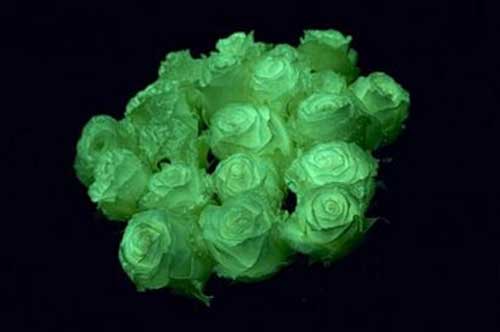
It’s a simple process. Just drain the contents of a magic marker into a jar of water. Cut the stems off of some flowers and stick them in the jar. Let the flowers sit in the solution overnight. In the morning, after they have absorbed the fluorescent dye, they’ll glow in the dark when exposed to ultraviolet light.
You can make... GLOW STICKS:

Neat Trick...(the secret is chemistry)
The liquid is just water. The spoon is made of pure gallium and is completely solid.
BUT... because of the low melting point of gallium (only about 30 degrees)... the spoon disappears!
BUT... because of the low melting point of gallium (only about 30 degrees)... the spoon disappears!
Tuesday, February 15, 2011
Bio 30 - DNA Replication and Protein Synthesis Links
DNA Replication Video:
DNA Transcripion/Translation Video:
DNA Replication Animation:
(Please go through the entire animation)
http://www.wiley.com/college/pratt/0471393878/student/animations/dna_replication/index.html
Transcription Animation:
http://bcs.whfreeman.com/thelifewire/content/chp12/1202001.html
Translation Animation:
http://bcs.whfreeman.com/thelifewire/content/chp12/1202003.html
This website has shorter animations of Replication, Transcription, and Translation with quizzes as you work through the steps. To get to the other processes, use the left toolbar.
http://highered.mcgraw-hill.com/sites/0072507470/student_view0/chapter3/animation__protein_synthesis__quiz_3_.html
DNA Transcripion/Translation Video:
DNA Replication Animation:
(Please go through the entire animation)
http://www.wiley.com/college/pratt/0471393878/student/animations/dna_replication/index.html
Transcription Animation:
http://bcs.whfreeman.com/thelifewire/content/chp12/1202001.html
Translation Animation:
http://bcs.whfreeman.com/thelifewire/content/chp12/1202003.html
This website has shorter animations of Replication, Transcription, and Translation with quizzes as you work through the steps. To get to the other processes, use the left toolbar.
http://highered.mcgraw-hill.com/sites/0072507470/student_view0/chapter3/animation__protein_synthesis__quiz_3_.html
Thursday, February 10, 2011
Bioluminescent Bacteria
The Gippsland Lakes are a chain of lakes in eastern Victoria, Australia. A combination of fire and floods changed the conditions of the water and led to the proliferation of Synechococcus, a photosynthetic cyanobacteria.
BUT... the most interesting thing about these bacteria is that they are bioluminescent, or "glow" when there is any movement. This means that this bacteria will light up when there is a wave or ripple in the water, and wherever people played in the water. Read more about bioluminescence here.
Here are some spectacular pictures of these lakes. You can also see more here.


This is a picture of a rock skipping across the water.
BUT... the most interesting thing about these bacteria is that they are bioluminescent, or "glow" when there is any movement. This means that this bacteria will light up when there is a wave or ripple in the water, and wherever people played in the water. Read more about bioluminescence here.
Here are some spectacular pictures of these lakes. You can also see more here.


This is a picture of a rock skipping across the water.
Wearable Pollution Monitor!
Warning Signs is a visualization of the pollution that exists invisibly all around us. When the wearable senses carbon monoxide, the piece subtly changes color and pattern to indicate higher levels of carbon monoxide in the atmosphere to the wearer and those around him or her. This piece was designed and created by Nien Lam and Sue Ngo. You can learn more about these designs here.


Solar Wind Bridge
This bridge that harnesses both solar and wind energy has been designed by Italian architects.
The structure represents a bridge with large wind turbines mounted under it, between the pillars. The bridge will traverse a valley with large open space and the wind turbines will operate at high altitude where the speed of wind is higher, thus more green energy will be collected.
In addition, the "Solar Wind" will be able to harness solar energy, since its entire road will be covered with a dense network of solar cells. The latter will be coated with a see-through and highly resistant type of plastic.


It was said that the bridge will be able to generate 40 million kWh per year! (This would power half of the United States -- the largest energy consumer -- for the entire year.)
The structure represents a bridge with large wind turbines mounted under it, between the pillars. The bridge will traverse a valley with large open space and the wind turbines will operate at high altitude where the speed of wind is higher, thus more green energy will be collected.
In addition, the "Solar Wind" will be able to harness solar energy, since its entire road will be covered with a dense network of solar cells. The latter will be coated with a see-through and highly resistant type of plastic.


It was said that the bridge will be able to generate 40 million kWh per year! (This would power half of the United States -- the largest energy consumer -- for the entire year.)
Science Art - Quilled Anatomy
 Quilling is a craft that involves coiling strips of paper and gluing them into different shapes. Sarah Yakawonis is an artist that has started to study anatomy through the art of quilling. You can follow her different projects on her blog: http://yakawonis.blogspot.com/


Her attention to detail is very impressive!
Sunday, January 16, 2011
Historic Change: Just in time for the International Year of Chemistry

The year 2011 has been designated as the International Year of Chemistry. The IYC is an official United Nations International Year, proclaimed at the UN as a result of the initiative of IUPAC and UNESCO.

For the first time in history, a change will be made to the atomic weights of some elements listed on the Periodic table of the chemical elements posted on walls of chemistry classrooms and on the inside covers of chemistry textbooks worldwide. IUPAC will feature the change in the standard atomic weights table as part of associated IYC activities. The new table, outlined in a report released this month, will express atomic weights of 10 elements -- hydrogen, lithium, boron, carbon, nitrogen, oxygen, silicon, sulfur, chlorine and thallium -- in a new manner that will reflect more accurately how these elements are found in nature.
Analytic techniques have improved so that we can more precisely measure atomic weight and scientists have found that some are not static, but will be expressed in intervals. For example, sulfur is commonly known to have a standard atomic weight of 32.065. However, its actual atomic weight can be anywhere between 32.059 and 32.076, depending on where the element is found. Read more on the Science Daily website.
 National Geographic's new issue that by the end of 2011 we will have 7 billion people on the planet. This brings up lots of interesting issues to do with education, energy, housing, sanitation, and food.
 Venezuela
 Sharing a hillside with high-rise apartment dwellers, children dance at a shop in one of the squatter communities that ring Caracas, a city of three million. One in seven people on Earth lives in slums today. Providing them with better housing and education will be one of the great challenges facing a world of seven billion people and counting.
 United States
 A new house went up every 20 minutes during the 2004 building boom that seized Las Vegas and its sprawling suburbs, like Henderson. The American lifestyle—characterized by gas-thirsty cars and big houses using lots of electricity—contributes to the country's energy appetite; its carbon emissions are four times higher than the global average.
 The article and National Geographic website focus on the importance of balance in our world. Watch the great video below:
Bad Movie Physics
 Report card time: Click on the above image to read more clearly.
Just to expand on the above categories...
- There's no sound in space
- Not all planets have Earth gravity
- Planets should have diverse climates, instead of one unified climate across a "desert planet" or "forest planet."
- It shouldn't be too easy to communicate with alien creatures, without some kind of high-technology "translator" explanation.
- And it definitely shouldn't be too easy for humans to interbreed with aliens.
- Humans exposed to vacuum without a spacesuit shouldn't explode or shatter. And a "hull breach" where the ship's crew is exposed to vacuum should kill everyone instantly.
- You can't have fires in space, unless there's oxygen leaking out somehow.
- Asteroids or other objects shouldn't be able to float close together without falling into each other's gravity
- People shouldn't be able to dodge lasers and other speed-of-light weapons
- And there's no reason why someone would move in slow-motion in zero gravity.
- Faster-than-light travel is probably not ever going to be possible.
Down the Hatch
 19th century laryngologist, Dr. Chevalier Jackson, preserved some interesting specimens from his patients.
He preserved more than 2,000 objects that people had swallowed or inhaled: nails and bolts, miniature binoculars, a radiator key, a child’s perfect-attendance pin, a medallion that says “Carry me for good luck.” Jackson retrieved these objects from people’s upper torsos, generally with little or no anesthesia. He was so intent on assembling his collection that he once refused to return a swallowed quarter, even when its owner threatened his life.
He was an early safety advocate for children chewing before swallowing. You can read more about his bizarre collection and interesting techniques here.
His collection will be on display at a museum in Philadelphia, and his biography has been recently written in "Swallow: Foreign Bodies, Their Ingestion, Inspiration, and the Curious Doctor Who Extracted Them" by Mary Cappello.
Baking... with science!
 Gel electrophoresis cookies pictured above. Gel electrophoresis is a technique to separate DNA fragments to make a "DNA fingerprint" that can be compared to DNA samples. This is used in forensics, paternity testing, and in genetics laboratories.
 Geological layers cake.
 Labware cookies!
Yum.
Monday, December 27, 2010

Smallest Periodic Table Written on a Hair
 Scientists at The University of Nottingham have written what they believe is the world's smallest periodic table -- on the side of a human hair. The table is so small that a million of them could be replicated on a typical post-it note.
Researchers at the University of Nottingham created a special birthday present for Martyn Poliakoff, a professor of chemistry. It’s a periodic table of the elments inscribed on the surface of a hair from Poliakoff:
Professor Poliakoff said: “Although the application was lighthearted I felt that it enabled us to show people how such nano writing is done. Our microscopist, Dr Mike Fay, made the whole operation seem so simple and really demystified it in a most appealing way.”
Read more and watch videos here.
Fly Geyser
 This is a geothermal geyser found in Nevada, which originally started when the landowners were drilling for the water.
The water from the geyser is thrust skywards on a continual basis. The spouts of water squirt out two meters in the air, spraying the surrounding thirty or more pools with a fresh source of water. The different mix of minerals (which includes sulphur) reacting with the oxygen in the air help to give the geyser its glorious colors.
The multiple spouts mean that a single cone of enormous size has not been able to develop. Yet the alien looking mound is something quite extraordinary, especially with its myriad of colors. The other factor in the strange coloration of the mound is the fact that it is covered with thermophilic algae which as a heat tolerant microorganism thrives in this sort of hot environment.
See more pictures of the geyser and read more here.


Make Contest: Robotic Plant
 This was a post after the Make Contest for building a robotic plant. It can grow or retract. Fun!
World's Biggest Cave

 National Geographic presents The World’s Biggest Cave, a TV special that gives us a close-up look at Son Doong, a huge recently-discovered underground labyrinth in Vietnam.
A half-mile block of 40-story buildings could fit inside this lit stretch of Hang Son Doong, which may be the world’s biggest subterranean passage.
Subscribe to:
Posts (Atom)